
Wheel Brake Clearance Explained: Why PCD, Size & Offset Aren’t Enough
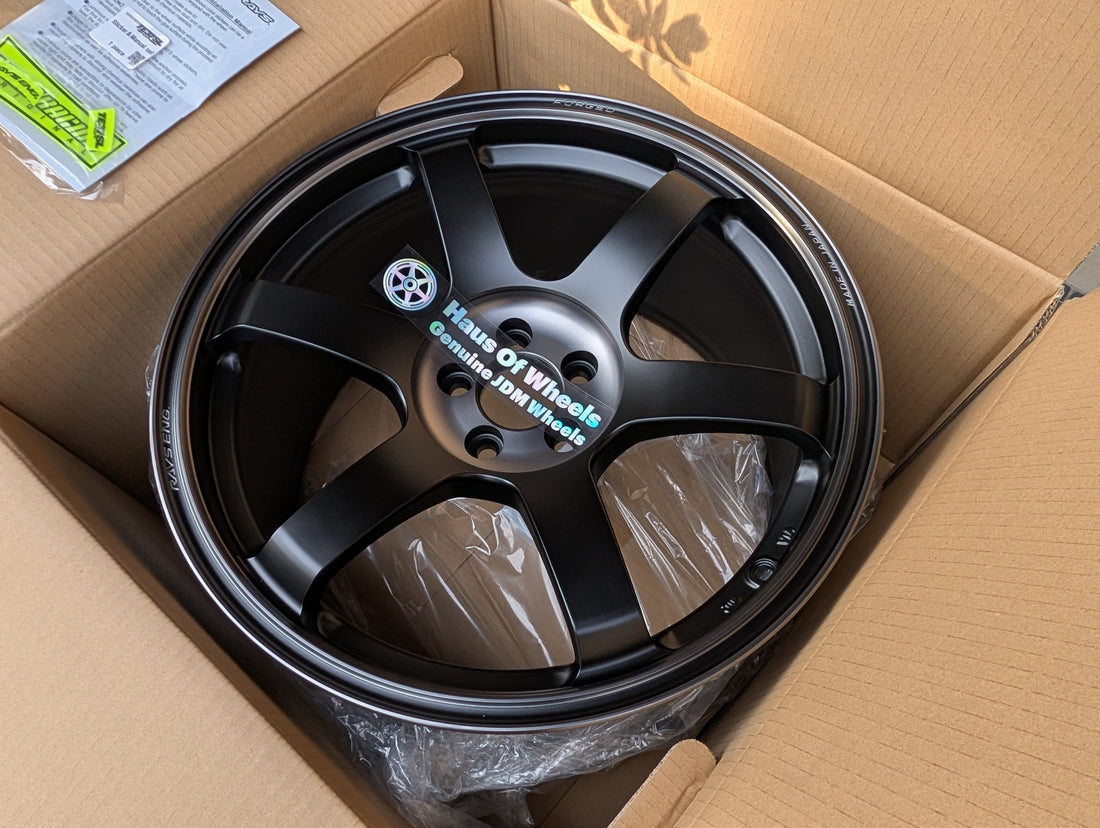
Correct PCD, diameter, width and offset do not guarantee that a wheel will clear your brakes. Performance brake packages can have large calipers that interfere with the spokes or inner barrel even when the wheel otherwise appears to be the correct size.
Why brake clearance is a separate fitment check
Wheel fitment is three-dimensional. The wheel has to clear the hub, suspension and bodywork, but the inside of the wheel also has to clear the brake disc and caliper.
Two wheels with exactly the same 18x9.5 +38 5x114.3 specification can have completely different spoke shapes and barrel profiles. One may clear a Brembo caliper while the other touches it.
Radial brake clearance
Radial clearance is the space between the outermost part of the brake assembly and the inside barrel of the wheel. This is why wheel diameter matters, but diameter alone is not enough. Barrel shape, drop centre and internal machining vary between wheel designs.
An 18-inch wheel can clear a particular brake package while another 18-inch design may not.
Axial or spoke-to-caliper clearance
The face of a brake caliper can sit very close to the back of the wheel spokes. This is often the critical dimension on fixed multi-piston calipers.
Wheel face design matters here. Concave, flat and different spoke profiles can change caliper clearance independently of the printed offset.
Why offset does not tell the whole story
Offset describes the location of the wheel mounting pad relative to the wheel centreline. It does not describe the shape of the spokes between the hub and rim.
A lower offset can sometimes create more room between the caliper and spokes on a particular design, but it also moves the wheel outward and may create guard-clearance problems. It should not be treated as a universal brake-clearance fix.
Vehicles where brake clearance deserves extra attention
Brake clearance is especially important on cars with factory or aftermarket multi-piston calipers, including many WRX STI, Mitsubishi Evo, GT-R, Civic Type R, GR Corolla and performance BMW applications.
Use the model-specific starting points in our VB WRX / tS Brembo guide, GR86 / BRZ Brembo guide, DC5 Type R guide, Evo 7/8/9 guide, R35 GT-R guide and FL5 Civic Type R guide.
How brake clearance is normally checked
- Use a manufacturer brake-clearance or caliper template where available.
- Compare the exact wheel model, diameter, width, offset and face specification.
- Confirm whether the vehicle has standard or upgraded brakes.
- Check whether different variants of the same wheel use different spoke faces or disk types.
- Allow sensible clearance rather than treating near-contact as acceptable.
What about wheel spacers?
A spacer changes the wheel's position relative to the hub and can increase spoke-to-caliper clearance in some situations, but it also reduces the effective offset and moves the wheel outward. That can affect guard clearance, fastener engagement, bearing loads and legal or engineering requirements.
Do not use a spacer as a substitute for selecting a properly compatible wheel without checking the complete setup.
Centre bore and wheel hardware still matter
Brake clearance is only one part of the installation. The wheel must also have the correct PCD and suitable centre-bore arrangement, and the correct wheel nuts or bolts must be used. See our PCD guide, centre-bore guide and wheel-nut guide.
Before ordering
If your car has large factory brakes or an aftermarket big-brake kit, provide the exact brake specification when asking about wheels. The more precise the brake information, the easier it is to avoid buying a wheel that is dimensionally correct but physically incompatible.
Browse genuine wheels currently available from HausofWheels, or send a fitment enquiry with your vehicle, year, brake package and desired wheel size.
Brake clearance must be confirmed for the exact vehicle, brake package and wheel specification. Do not rely on diameter, PCD or offset alone.